
THE PRACTICAL ANSWER
TTFT measures the first-token wait; decode describes delivery after that point; served rate includes the whole request window. Compare only results whose model, workload, conditions and denominator match.
TTFT tells you how long you wait for the first token. Decode rate describes output generation after that point. Served rate divides output tokens by the request's total elapsed time. Read all three with the workload and timing definition beside them: a fast stream can still follow a long wait.
The examples below come from separate community experiments. Each explains a metric in its own configuration. RunAIHere has not independently reproduced these measurements.
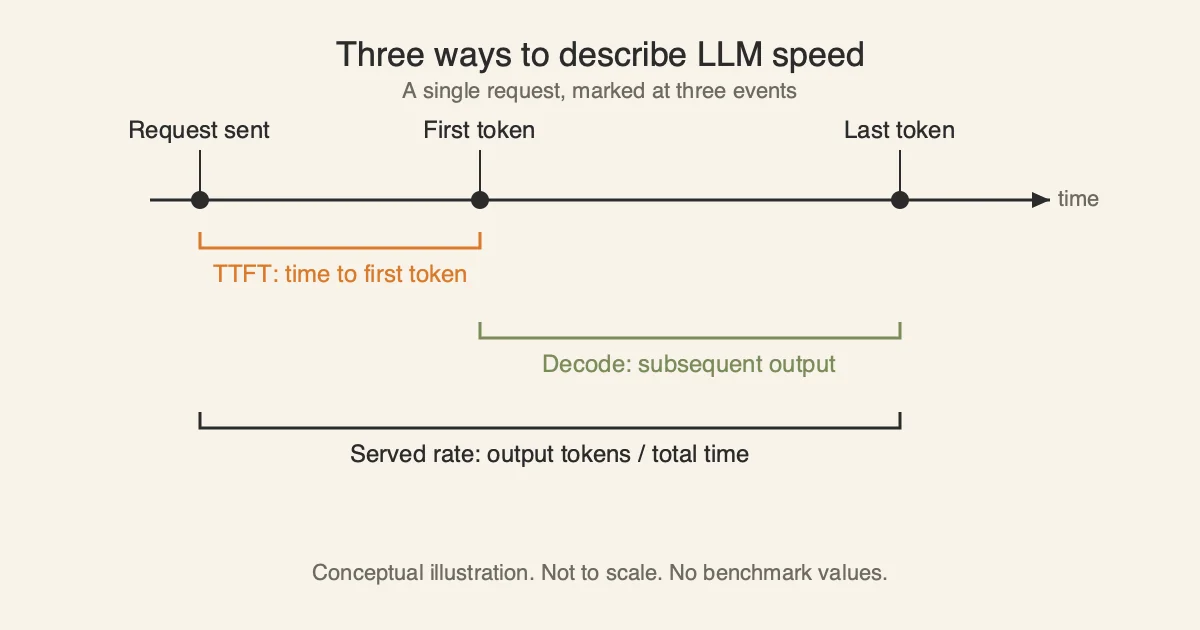
Conceptual illustration generated as SVG by the local Spark text model and reviewed by RunAIHere. Not to scale; no benchmark values.
Read the clock before the headline
Start by identifying when the author starts and stops the timer. Does the reported interval include queueing, prompt processing or a cold start? Was the server already warm? Does an output-rate calculation include the first-token wait? Those choices determine what a reader can infer from a tokens-per-second figure.
For an interactive session, both the initial wait and subsequent delivery affect the experience. A batch-serving report also needs its concurrency and aggregation rules. Keep an aggregate throughput figure separate from a per-request or per-stream rate.
TTFT: waiting before the first token
One dated report used an Apple M4 Pro with 64 GB unified memory, MLX 0.31.0 and mlx-lm 0.30.7. For Qwen3.5-4B int4, the 4,096-token-input test reported mean TTFT of 6.14 seconds, with standard deviation 0.25 seconds, across 20 measurements after one warmup iteration. This describes that input shape and setup. The report's generation-rate test used a different input length, so keep those profiles distinct. Original measurement row
Decode: the generation phase
A four-DGX-Spark report using TP4 and DSpark k5 reported 43.12 tokens/s as mean per-stream decode at concurrency one, averaged across eight categories with counting excluded. Input and output shapes varied by category; the source reports one batch per cell. It concerns a DeepSeek V4.1 Flash launch checkpoint. The record does not establish performance for DeepSeek-V4.1-Flash-1017. Original report and row
Served rate: the whole request window
A different operator defines served rate as output tokens divided by whole-request wall-clock time, including first-token waiting. Its two-Spark DeepSeek-V4-Flash-0731 agentic test at approximately 33k context reported 22.5 tokens/s, the median of three campaigns. That cell used concurrency one, 512 output tokens with ignore-eos enabled, prefix caching off and full-shape warmup. The reported spread ratio was 1.04; this is a descriptive spread across those campaigns, not a confidence interval. Original method and result
The two DeepSeek examples use different checkpoints and hardware counts. Their values do not provide a controlled comparison between the machines or models.
A checklist before choosing a deployment
- Match the exact checkpoint, quantization, runtime and hardware topology.
- Record input length, output length, concurrency and stopping rules.
- Keep cache, warmup and speculative decoding settings with each result.
- Retain the statistic and repetitions; distinguish standard deviation, observed spread and confidence intervals.
- Check missing conditions in the original report before treating a nearby configuration as equivalent.
The accompanying timeline is conceptual and has no measured scale. Its purpose is to show which interval each metric describes. The linked original reports remain the authority for their measurements.
Continue with the source material
Original sources and evidence boundary
Checked 2026-10-18. Source declarations and community measurements retain their own conditions. No independent model benchmark was run by Run AI Here.
- weklund · measurements/llm_benchmarks/Apple_M4_Pro_10P+4E+20GPU_64GB/2026-03-06__19:47:24/REPORT.md Document revision:
5ae9b491f7a0539d5abef949eded6bd57785a981Document checksum and matching source record
SHA-256
Read source conditions →ff21a1f8a2597867e191a376cea28af293d47dfff82bb423193009b05c7ef5a3 - tonyd2wild · README.md Document revision:
d45538f67366c62da668c35ec1afd4fcd0e4c8b4Document checksum and matching source record
SHA-256
Read source conditions →8c72dbb42a49a0f9b5b5f8a70055a467823993012bdb47cad748b5b0e04e36a7 - WeZZard · README.md Document revision:
25e8dbf1b6113dd0b3f12d27a670fb284944d260Document checksum and matching source record
SHA-256
Read source conditions →b815d32807147f9638b1abbeadc02af257c55bd1f7651a123e5a8090bebe7469
AI-assisted draft, reviewed and edited by Run AI Here. Conceptual SVG generated by the local Spark text model and reviewed by Run AI Here; no measured scale. Original authors retain attribution. Corrections should identify the source revision and affected statement.